
The plan
An atlas stone does not care how pretty your barbell clean looks. The stone has no handle, no knurling, and no friendly rack position. It sits on the floor, asks you to get close, and punishes the athlete who tries to curl it with tired arms.
In CrossFit, atlas stones usually show up as odd-object loading, stone-to-shoulder work, or strongman-style conditioning. The movement is simple to describe: pick up the stone, lap it, stand, and load it or shoulder it. The details are where backs get smoked and reps get missed.
- The lap is the reset point. Do not rush past it if the stone is heavy or awkward.
- Arms hold the stone close, but the legs and hips should do most of the loading.
- Scale the object, height, or range before turning every rep into a bent-back wrestle.
What the atlas stone changes compared with a barbell
A barbell lets you keep the load close with a straight handle. An atlas stone makes that harder. The weight sits in front of the body, the surface can slip, and the athlete has to create pressure with the forearms, chest, and upper back.
That is why the stone has more in common with sandbag clean control and D-ball over shoulder setup than with a clean barbell rep. You still need leg drive and timing, but the object will not meet you halfway. You have to wrap it, pin it, and move around it.

Start close and win the first pull
The first pull should feel crowded. Feet near the stone, hips low enough to push through the floor, arms wrapped as far around the stone as possible. If the stone starts too far away, the athlete usually reaches, rounds, and tries to save the lift with the biceps.
Good deadlift bracing still matters, but the setup is not identical. With a stone, the back angle may be more rounded than a textbook barbell deadlift because the object is round and low. The goal is not a perfect barbell shape. The goal is a strong, tight position where the stone stays glued to the body.
| Fault | What it looks like | Fix to try |
|---|---|---|
| Stone starts too far away | The athlete reaches and the hips shoot up | Step closer, wrap deeper, and push the floor away |
| Arms try to curl it | Biceps take the strain and the stone drifts | Keep arms long and think squeeze, not curl |
| Lap is skipped | The stone never settles before the load | Sit it on the thighs, reset the grip, then extend |
| Load gets rushed | The athlete bumps the platform and loses the stone | Stand tall first, then guide the stone to the target |
The lap position is not a pause for show
The lap is where the athlete buys time. Once the stone is pulled to the thighs, sit back enough to let it settle, then rewrap higher if needed. This is also the moment to breathe. One calm breath in the lap often saves more energy than a frantic attempt to muscle the stone straight to the platform.
Think of the lap like the catch in power clean timing. It gives the rep a middle point. Skip it too early and the next phase becomes a gamble. Own it, and the load feels much less random.
The demo below is worth watching because it shows the stone as an odd object, not as a neat barbell pull. Watch the lap position first. That is where the rep either gets organized or turns into a rounded-back fight.
Stand with the stone, then load it
After the lap, the job is to extend hard through the hips while keeping the stone close. The athlete should feel the stone roll upward on the torso, not swing away from the body. If the hips do not finish, the arms have to finish the rep alone. That is where misses happen.
This part feels familiar to athletes who have practiced tire flip leg drive or yoke carry posture. Odd objects reward patience first, then aggression. Get organized, push through the ground, and finish tall before trying to place the object.
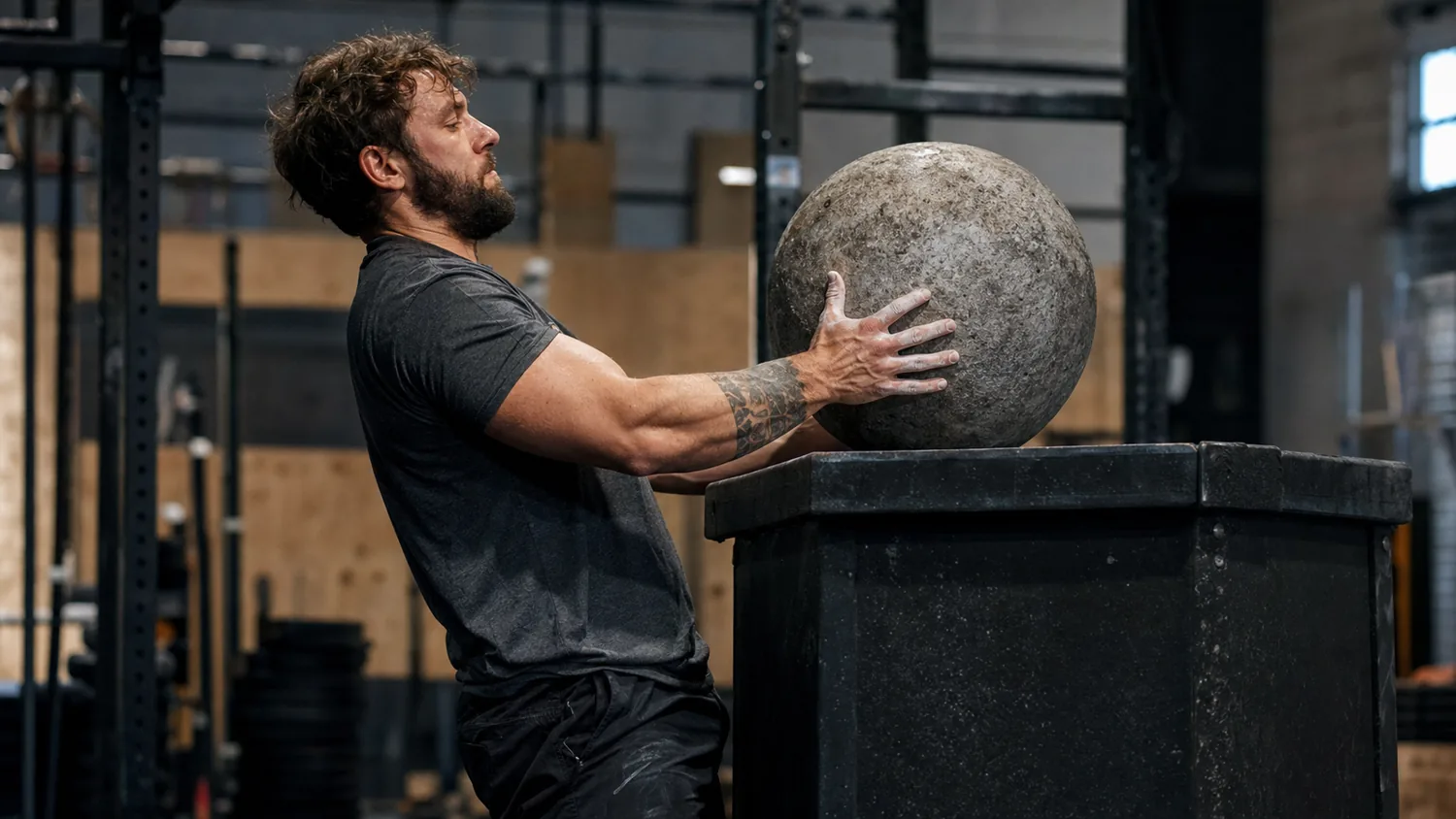
How to scale atlas stones in a CrossFit class
Useful CrossFit scaling keeps the odd-object problem without forcing a bad lift. If the full stone is too heavy, use a lighter stone, D-ball, sandbag, or plate-loaded substitute. If the platform is too high, lower the target. If the athlete cannot lap the object cleanly, stop there and build that piece first.
Newer athletes can also practice stone deadlifts to the lap, then separate loads from a higher starting point. That keeps the session moving without pretending the full rep is ready. For conditioning workouts, a lower loading height often keeps the intended pace better than a heavy object that turns every round into a max effort.
Pacing stone reps when the workout gets hot
Atlas stones feel manageable when they are fresh. They change fast after burpees, running, or sled work. If the workout includes sled drag pacing, box jumps, or carries, assume the hips and lungs will be taxed before the stone even starts.
Singles are usually the clean choice. Step in, lift, load, step back, breathe, and repeat. Touch-and-go stone reps can work with a light object, but most athletes get more value from repeatable singles than from one fast set followed by a long stare at the floor.
What to practice before the next stone workout
Before adding speed, check three pieces. Can you pull the stone to the lap without your arms bending early? Can you rewrap in the lap without losing pressure? Can you stand and load without the stone drifting away from your chest?
If one piece is missing, keep the practice boring for a few weeks. Use stone deadlifts, lap holds, light loads to a low platform, goblet squat depth, and controlled carries. The athlete who can repeat clean stone reps at moderate weight will beat the athlete who survives one heavy rep and spends the next minute shaking out the forearms.


