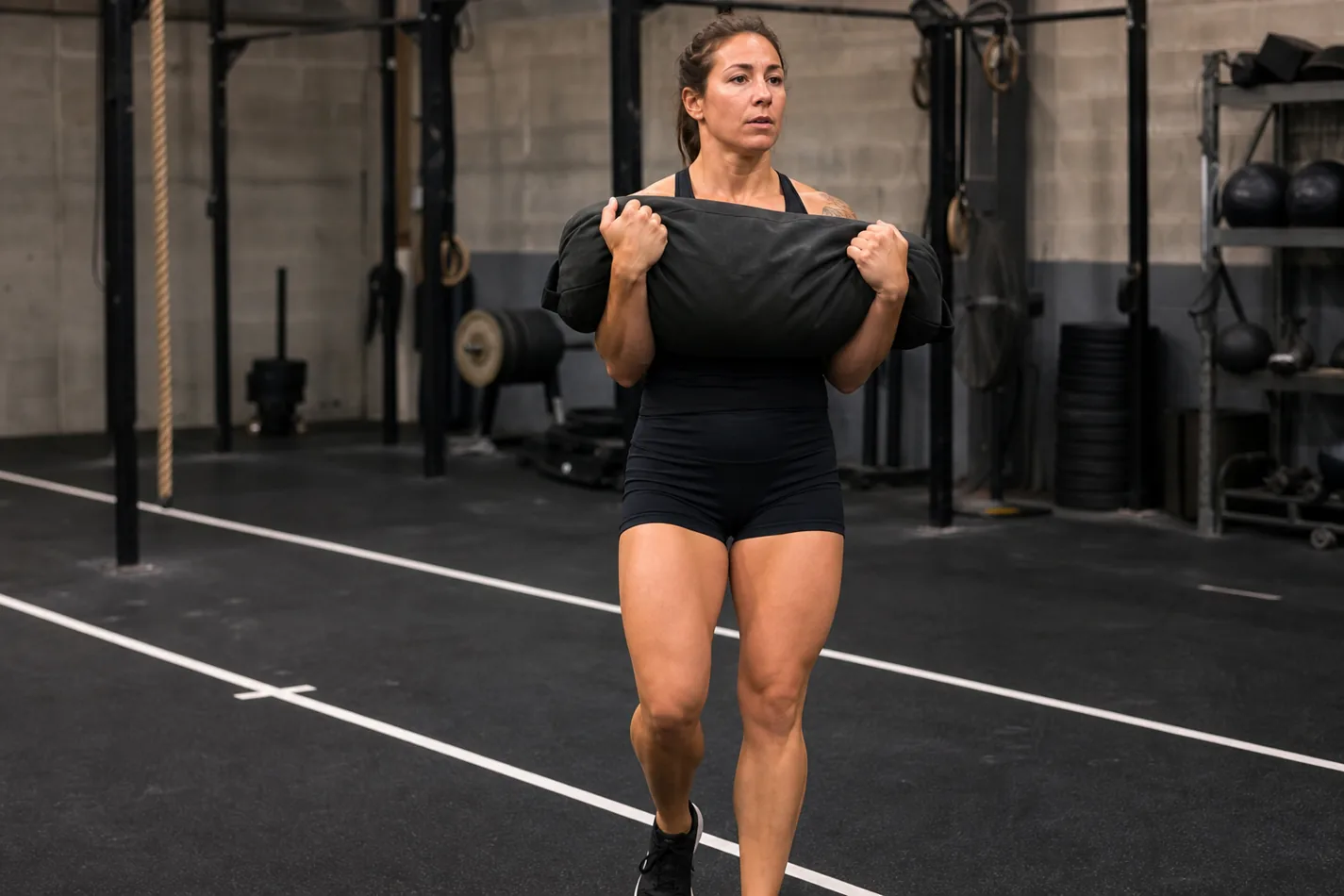
The plan
A Zercher carry puts the load in the crooks of the elbows and makes hiding almost impossible. The athlete has to walk while the sandbag, bar, or yoke wants to pull the upper back forward. If the trunk gives up, the carry turns into a slow fold.
That is why the movement can be useful in CrossFit training. It is not flashy. It is a blunt test of bracing, breathing, posture, and patience under an awkward load.
- Keep the load close enough that the elbows support it without yanking the shoulders forward.
- Walk with short, steady steps. A rushed Zercher carry usually means the brace is already gone.
- Scale load or distance before the athlete starts rounding hard or holding breath for the whole lane.
What a Zercher carry trains
The Zercher carry trains the space between strength and position. The arms are holding the object, but the real work sits in the trunk, upper back, hips, and breathing pattern. The load presses into the body. The athlete has to stay tall anyway.
Compared with front rack carries, the Zercher position usually feels lower and more compressed. Compared with farmer carry grip or suitcase carry control, grip is not the main limiter. The harder question is whether the athlete can keep the rib cage stacked over the pelvis while walking.
Start with the pickup, not the walk
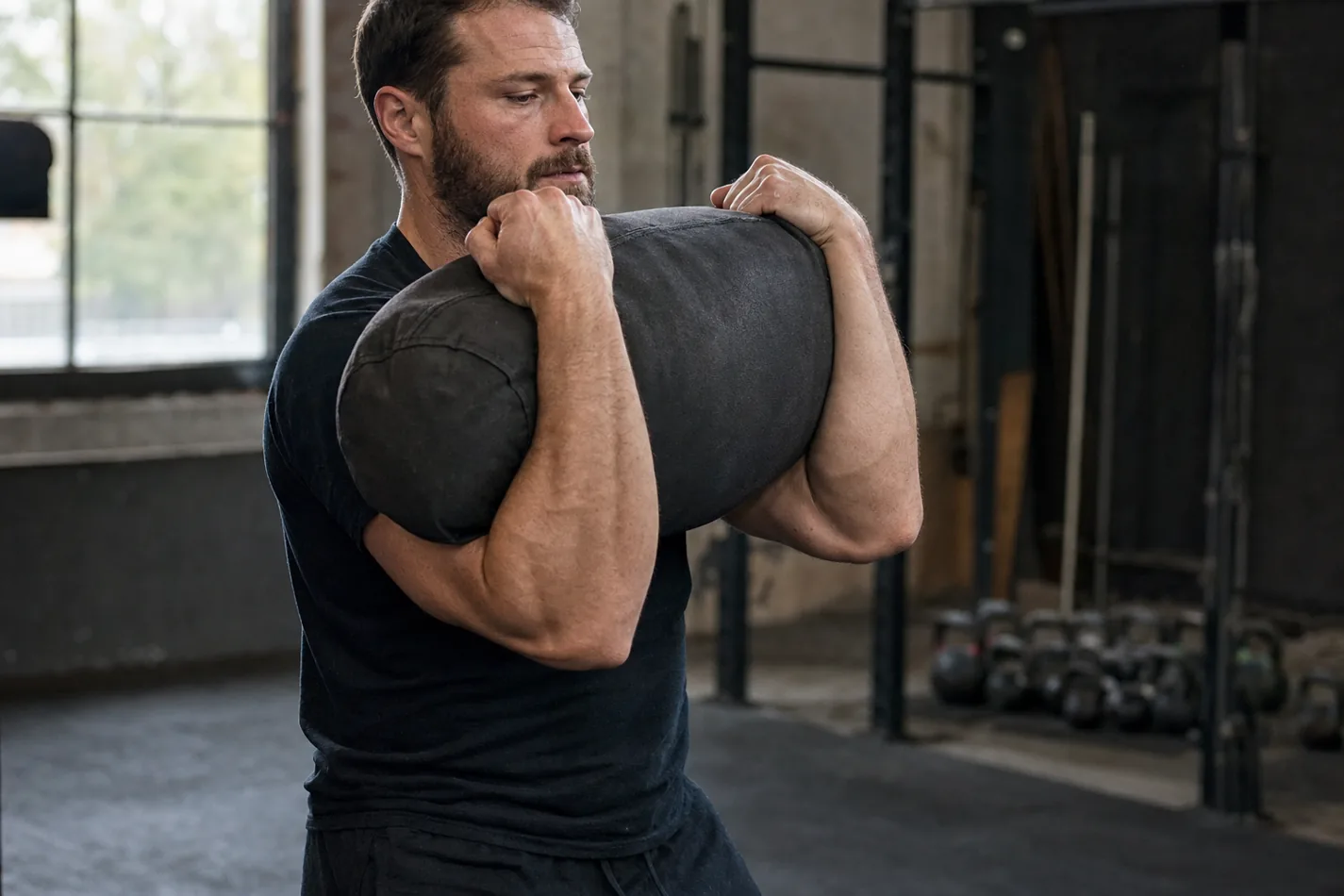
A messy pickup usually creates a messy carry. With a sandbag, hug the bag close, lap it if needed, then pull it into the elbow crease before standing. With a barbell, use a rack when the goal is carry quality, not a circus lift from the floor. With a yoke, set the handles so the athlete can lift without curling the whole load into place.
The first check is simple: can the athlete stand still for three calm breaths before walking? If not, the carry is too heavy or the setup is wrong. This is the same lesson that shows up in deadlift setup and front squat rack position. Own the start before adding speed.
| Fault | What it usually means | Fix before the next set |
|---|---|---|
| Upper back rounds right away | The load is pulling the athlete forward before the walk starts | Use less weight and reset the object closer to the body |
| Elbows drift down and open | The arms are losing the shelf position | Squeeze the load in and shorten the distance |
| Breath gets stuck | The brace is too rigid to survive the lane | Use small breaths while keeping the ribs quiet |
| Steps get long and loud | The athlete is trying to escape the load | Walk shorter, slower, and stop before position breaks |
Where it fits in a CrossFit workout
Zercher carries work well as a strength accessory, strongman station, or odd-object piece in conditioning. They pair naturally with sandbag carry work, sled work, box step-ups, and heavier carries where athletes need to move under pressure without losing shape.
They are less useful when the workout already has a lot of spinal fatigue. If the day includes heavy deadlifts, high-volume cleans, or long sets of wall balls, a heavy Zercher lane may add more fatigue than skill. In that case, a lighter carry after a CrossFit warm-up is usually cleaner.
The demo below is worth watching for one detail: the load stays glued to the body while the athlete keeps walking. Look at the elbows and rib cage before you look at speed.
Load, distance, and breathing
Start with a distance the athlete can repeat without a fight. Twenty-five to fifty feet is enough for most training pieces. The weight should feel annoying but not chaotic. If the athlete cannot breathe without the load sliding down the arms, the set is no longer teaching the right thing.
A good cue is "close load, quiet ribs, normal feet." The feet should not turn into a shuffle unless the implement forces it. The torso should not hinge more on every step. When the carry starts to turn into survival, stop, reset, and make the next set cleaner.
Scaling without losing the lesson
Good CrossFit scaling keeps the demand on bracing and posture. Use a lighter sandbag, a shorter lane, or a front rack variation if the elbow position is the blocker. If the athlete cannot hold the object safely, switch to yoke carry bracing or a controlled bear-hug carry before chasing a heavier Zercher version.
For newer athletes, a static Zercher hold can be enough. Pick up the object, stand tall for ten to twenty seconds, breathe, then set it down with control. Once that looks boring, walking makes sense.
What to test next
Film one set from the side. The answers are hard to fake. Does the object stay close? Do the ribs stay down? Do the steps look like walking, or does every stride look like the athlete is trying not to collapse? Add weight only when those answers stay boring for the full lane.


