
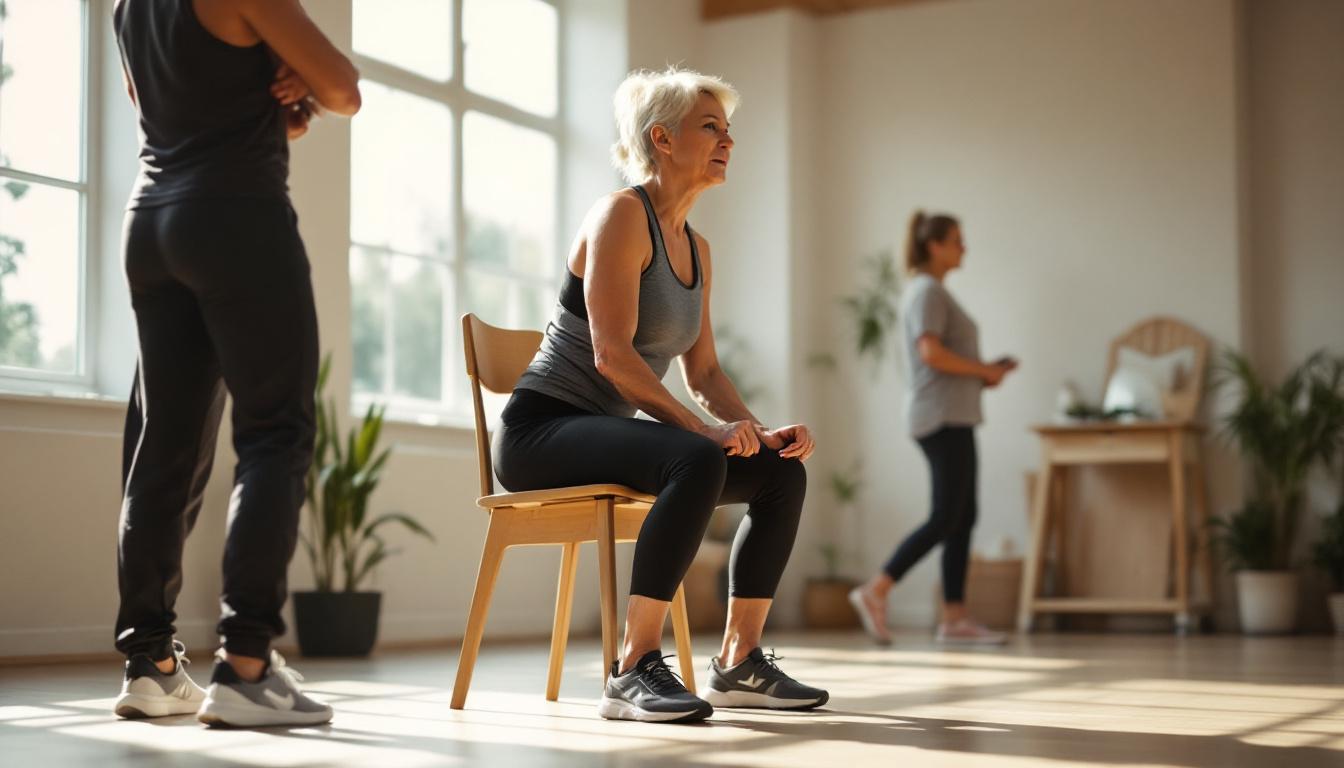

The ability to maintain strong legs after age 60 profoundly impacts independence and quality of life. While gyms offer machines and specialized equipment, simple chair exercises effectively assess and build essential leg strength for seniors. These movements mimic everyday challenges—from rising calmly from a chair to balancing on one leg—targeting lower body muscles and functional mobility. Understanding how to perform these tests and interpret results helps individuals monitor their fitness status and take action before strength declines impact daily activities and fall risk.
Chair Exercises Unlock Functional Fitness
Leg strength after 60 is less about athletic performance and more about independence. Chair exercises provide valuable insight beyond traditional workouts because they simulate real-life movements crucial for daily function. Standing up from a chair without using hands tests lower body muscles’ power and control, reflecting the ability to rise from couches, toilet seats, or car seats. These actions engage the quads, glutes, and hip flexors, determining if the body can execute safe, balanced transitions between sitting and standing.
Unlike isolated gym machines, chair movements demand coordination and balance alongside muscle strength. For example, standing repeatedly within 30 seconds challenges muscular endurance and power, factors vital for sustained activity like shopping trips or household chores. Additionally, these exercises highlight muscle imbalances by isolating the strength of each leg—essential for catching oneself when off-balance or navigating uneven terrain.
The chair serves as a stable, accessible tool for those age 60+, eliminating intimidation from unfamiliar gym equipment while reducing injury fears. It encourages seniors to test and build strength safely, enhancing confidence to engage in wider physical activity. This functional focus ensures strength training aligns closely with the realities of aging bodies and everyday mobility demands.
Assessing Leg Strength with the 30-Second Chair Stand
This timed test measures leg power, endurance, and coordination by counting how many times a person can stand fully from a seated position within 30 seconds without arm assistance. Crossed arms prevent using the upper body, forcing the legs to do all the work. Mastery of this simple move requires full extension of hips and knees on standing, coupled with controlled descent to protect joints and improve eccentric muscle strength.
Age and sex-specific benchmarks exist to categorize performance into elite, strong, or needs improvement groups. For example, a woman aged 65-69 performing 16 or more repetitions rates in the elite range, highlighting exceptional fitness compared to peers. In contrast, fewer than 11 reps in the same group signals a need for focused strength training. This gradient classification informs personalized goals addressing individual deficits.
Beyond counting reps, quality matters. Avoiding momentum by keeping the torso upright ensures that power derives directly from leg muscles. Controlled sitting slows speed to emphasize muscle control and joint protection. These nuances differentiate a routine movement from an effective workout indicator integrated within a senior workout plan.
Single-Leg Chair Stand Exposes Imbalances and Balance
This unilateral movement focuses on each leg’s independent capacity to lift and stabilize body weight while the opposite leg remains extended forward. It challenges the leg’s strength, balance, and proprioception—critical components in preventing falls. Performing 5 clean reps per leg without hand support or wobbling classifies as elite leg strength, a benchmark indicating readiness for variable terrain and dynamic daily tasks.
Many seniors underestimate the importance of single-leg strength, yet real-life movements seldom engage both legs equally. Stairs, stepping over obstacles, and regaining balance after slips require robust unilateral control. Weakness or imbalance on one leg may lead to compensatory gait patterns, increasing risks of hip or knee issues and falls.
For those struggling, a progression from supported partial weight bearing to full single-leg stands with arms crossed fosters safe strength development. Consistent practice encourages proprioceptive improvements alongside muscular gains, delivering noticeable mobility improvement and balance confidence.
Mastering the Chair Sit-to-Stand with Pause for Stability
This advanced variation emphasizes balance and muscular control during the challenging transitional phase where knees form a 90-degree angle, and the thighs are parallel to the floor. Holding this halfway point for several seconds requires both eccentric and isometric strength, which are key to safely managing movements like descending stairs and preventing falls during daily activities.
Achieving five reps of controlled pauses denotes elite-level functional leg strength and balance, highlighting the body’s ability to stabilize during unstable phases. Those unable to hold the pause likely have deficits in force control, which may explain shaky or wobbly movements felt when standing up abruptly or changing positions.
The exercise’s slow tempo teaches muscle activation awareness, improving neural pathways and joint alignment simultaneously. Modifications such as initial slower rises without pause or using a slightly higher chair enable gradual adaptation. When integrated into a senior workout routine, these pause repetitions reinforce control, reduce injury risk, and enhance confidence in mobility.
Boosting Leg Strength Safely After 60
When leg strength tests highlight weakness or imbalance, a structured approach can restore elite fitness levels. Starting with slow, controlled chair stands without time pressure builds foundational strength. Using hand assistance initially helps overcome the hurdle of rising, with gradual reductions promoting independence. Similarly, single-leg stands evolve from supported partial weight shifts to full lifts, facilitating balance exercises tailored to individual progress.
Incorporating complementary lower body exercises like wall sits strengthens key muscle groups directly involved in chair movements. Heel raises target calf and ankle muscles, which enhance overall stability—a crucial element for reducing fall risk. Practicing these exercises multiple times daily, even by focusing on slow controlled movements during ordinary sitting and standing, accumulates meaningful strength gains.
Avoiding common mistakes such as rushing through reps, leaning excessively forward, or partial movements preserves technique integrity and maximizes benefits. Measuring progress repeatedly provides motivation and objective markers to maintain or improve functional fitness. Key points to consider for safe and effective leg strength training after 60 include:
- Choose a sturdy, non-slip chair without wheels and with a firm flat seat
- Cross arms or place them on hips to prevent cheating during exercises
- Gradually reduce assistance and increase control before advancing
- Perform exercises slowly to enhance muscle activation and balance
- Consult healthcare providers if recovering from surgery or managing joint pain
- Avoid sharp pain or unstable dizziness during exercises; adapt accordingly
By consistently applying these strategies, seniors can reclaim or maintain lower body strength essential for everyday independence and fall prevention. The combined insights from chair exercises offer a clear, simple path to understanding fitness status and unlocking sustainable mobility improvements well into the later decades of life.
