The plan
A timer can make a short workout feel deceptively intense. In a beginner Tabata session, the goal is not to sprint through every work interval or chase a four-minute finish; it is to move with control, recover enough to repeat the effort, and stop if your form breaks down.
The name comes from a specific research protocol, not a promise that four minutes can replace a complete training routine. Here’s what that study actually tested, how a lower-intensity version differs, and how to choose movements and assess your response.
What did the original Tabata study actually test?
“Tabata” is often used as shorthand for any workout with short intervals, but the original research tested a much more demanding cycle protocol. In the 1996 study, seven participants performed exhaustive exercise on a mechanically braked cycle: seven to eight bouts of 20 seconds at about 170% of VO₂max, with 10 seconds of rest between bouts. VO₂max is the maximum rate at which the body can use oxygen during exercise. The training schedule was five days a week for six weeks, according to the original Tabata study abstract.
That is not a beginner workout template. The researchers studied a specific cycling effort and a small group under a defined training schedule; those details do not establish that an untrained person should exercise all-out, copy the schedule, or expect the same results from bodyweight movements. A class that uses a 20:10 timer may borrow the format without reproducing the study protocol.
How should a beginner scale the intervals?
Keep the clock simple, but make the work interval controlled rather than maximal. A practical first trial is to perform a low-impact movement for 20 seconds, then rest or move very gently for 10 seconds, repeating for four rounds. That gives you two minutes of intervals, not the classic four-minute block. If you finish feeling steady and can keep your technique consistent, you can gradually add rounds in a later session.
This is a coaching-oriented starting point, not a tested Tabata prescription. You can also shorten the work period, lengthen recovery, or use a continuous easy pace instead. The right option is the one that lets you repeat the movement without breathless rushing, loss of balance, or joint discomfort. Stop if you feel pain, dizziness, chest discomfort, or unusual shortness of breath; seek medical advice for concerning symptoms.
Use the talk test to check intensity. The CDC says that at moderate intensity, you can talk but not sing. If you cannot speak a few words during these first sessions, ease off; a beginner does not need to hit an all-out effort to make the workout worthwhile. The talk test is a general intensity cue, not a medical assessment.
Which exercises are easier to control?
Choose familiar movements with a stable position and an easy way to reduce range or speed. For example, you might alternate chair sit-to-stands with marching in place, or use step-back lunges only if you can balance and control each repetition. If you train in a box, ask a coach to check your setup before you add pace. Keep the movement quality more important than the number of reps.
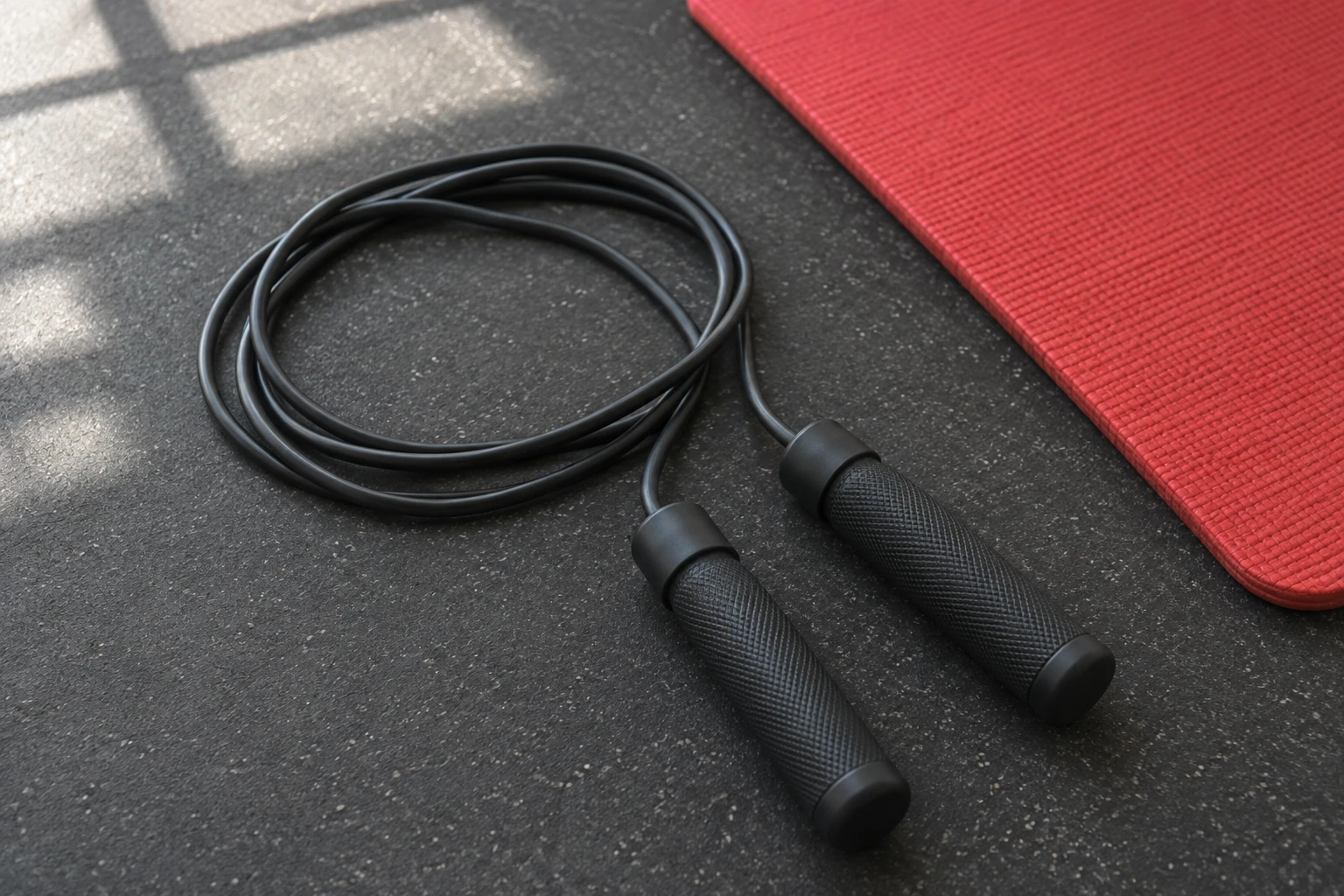
A stationary bike can make it easier to adjust resistance and avoid impact, but it is not automatically easy: keep the effort comfortable enough to recover between bouts. Jumping movements such as burpees, jump squats, and fast double-unders can be harder to control under fatigue. Save them until you can perform the underlying movement reliably and recover well. If you want to work on rope skills separately, start with a beginner jump-rope session and scale the bounce and volume to your current ability.
Before the timer starts, spend several minutes moving easily and rehearsing the movements at a comfortable pace. Set a timer you can hear, clear the floor, and decide on a simpler variation before you begin. The exact warm-up length depends on the person and activity; it should leave you prepared, not tired. After the intervals, keep moving gently until your breathing settles.
How does Tabata fit with the rest of your training?
A four-minute interval block is a small conditioning option, not a substitute for a balanced fitness routine. The CDC’s adult activity guidance calls for at least 150 minutes of moderate-intensity aerobic activity each week and muscle-strengthening activity on at least two days. Those weekly targets provide useful context: a short interval set by itself does not meet them.
Fit intervals around your priorities rather than forcing them into every workout. If strength quality is the focus, you may prefer to do conditioning after lifting or on another day; if cardio is the priority, you might place it earlier while fresh. The choice depends on your session goals, and choosing cardio before or after weights can help you think through that tradeoff. Do not add a hard interval session simply because the timer is short.
How can you tell whether the workout is working for you?
After each session, note the movement, interval length, number of rounds, perceived effort, and whether your technique stayed consistent. Also record how you felt later that day and the next day. You are looking for a repeatable effort and ordinary recovery, not a personal record in every session. If the last rounds turn into rushed, unstable repetitions, stop the set or make the movement easier next time.
Progress one variable at a time. You could add a round, extend the work interval slightly, or choose a somewhat more demanding variation, but changing everything at once makes it harder to judge what you can handle. If recovery worsens or pain appears, reduce the demand and consider professional guidance. A successful beginner session is one you can complete with control and fit into a broader routine, not one that imitates a research protocol designed to be exhaustive.
Questions fréquentes
Is a beginner Tabata workout really only four minutes?
The classic work-and-rest sequence adds up to four minutes, but a complete session takes longer once you include a warm-up, setup and cooldown. A beginner adaptation may also use fewer rounds or gentler intervals. Treat the timer as one part of a workout, not a measure of whether you have done enough exercise for the day.
How many times a week should I do Tabata as a beginner?
There is no single weekly frequency that fits every beginner, and the original study schedule is not a starting prescription. Begin with a session you can recover from, leave time between demanding workouts, and adjust based on how you feel. If you are unsure how intervals fit your training or health needs, ask a qualified clinician or coach.
Can I use burpees or jump squats?
You can choose them if you already perform them comfortably, but they are not required. Their impact and technical demands may make it harder to maintain controlled movement as you fatigue. Try a chair squat, step-back or brisk march first, and use a variation that lets you keep steady breathing and repeatable form.